How to Launch an Online Store in Dubai
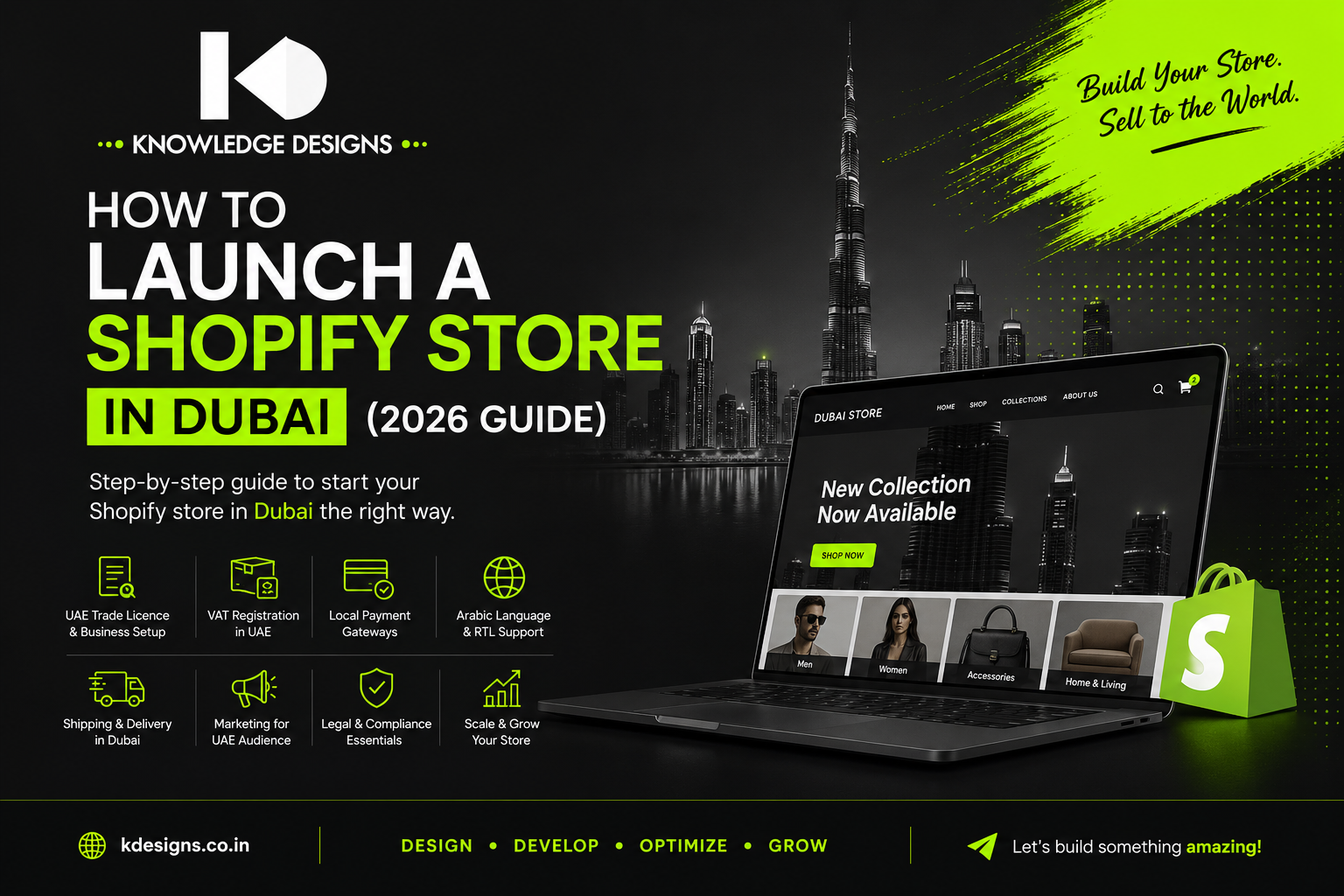
Get your UAE Trade Licence First
Before building anything, you need a valid UAE trade licence to legally sell online. You have two main options: a Mainland licence (via DED) or a Free Zone licence (via IFZA, SHAMS, Dubai South, etc.).
Free Zone licences are popular with solo entrepreneurs — they’re faster, cheaper (from ~AED 5,750/year), and allow 100% foreign ownership. The downside: you’ll need a local distributor to sell directly to UAE customers without an ecommerce exemption.
Dubai Tip
Many Shopify store owners register under a Free Zone “E-Commerce” activity licence — it explicitly covers online retail and makes your business fully compliant.
- Choose: Mainland DED or Free Zone
- Apply for “E-Commerce” or “Retail” trade activity
- Register for VAT with the FTA (if revenue exceeds AED 375,000/year)
- Open a UAE business bank account
Choose the Right Shopify Plan
Shopify offers several tiers. For most Dubai startups, the Basic plan ($29/month) is a solid starting point. If you’re scaling with multiple staff or need advanced reporting, move to Shopify ($79) or Advanced ($299).
- Basic – $29/moShopify – $79/moAdvanced – $299/moPlus – from $2,300/mo
- Pro tip: Pay annually to save 25%. Shopify also offers a 3-day free trial — use it to build your store before committing.
Set Up Your Store Essentials
- Once inside your Shopify dashboard, configure these key elements before adding products:
- Store name, currency (AED), and timezone (Gulf Standard Time, UTC+4)
- Choose and customise a theme (Dawn, Sense, or a premium theme)
- Add your logo, brand colours, and fonts
- Write product descriptions in both English and Arabic
- Enable RTL (right-to-left) layout for Arabic language support
- Set up essential pages: About, Contact, Refund Policy, Privacy Policy
Connect a UAE Payment Gateway
Shopify Payments is not available in the UAE, so you’ll need a third-party payment gateway. The most popular options for Dubai merchants are:
- Telr— UAE-based, supports AED, easy Shopify integration
- PayTabs— widely used across GCC, supports 168 currencies
- Network International— trusted by large UAE retailers
- Stripe— available via a UAE-registered business with international banking
- Cash on Delivery (COD)— still expected by many UAE shoppers; enable it as an option
Configure Shipping & VAT
UAE VAT is set at 5%. If you’re VAT-registered, you must display prices inclusive of VAT and provide tax invoices. In Shopify, go to Settings → Taxes and duties and enable UAE tax at 5%.
For shipping, you have a range of local and international carriers to choose from:
- AramexFetchrDHL ExpressEmirates PostQuiqup
- Same-day delivery
- Dubai customers increasingly expect same-day or next-day delivery. Fetchr and Quiqup are strong options for last-mile Dubai delivery and integrate directly with Shopify.
Go Live & Drive Traffic
Before clicking “Remove password,” run through this pre-launch checklist:
- Test a full purchase from cart to confirmation email
- Connect your custom domain (e.g., yourbrand.ae)
- Install Google Analytics 4 and Meta Pixel
- Submit your sitemap to Google Search Console
- Set up abandoned cart email flows in Shopify Email or Klaviyo
For traffic, prioritise Instagram and TikTok — Dubai shoppers are highly active on both. Google Shopping ads also perform exceptionally well for product-based stores in the UAE.
Work with a Shopify Freelancer in Dubai
Building a store yourself works — but if you want a professional result faster, hiring a Dubai-based Shopify freelancer means you get someone who understands the local market, UAE payment gateways, Arabic RTL layouts, and the cultural nuances of selling to Gulf consumers.
A typical Shopify store build in Dubai ranges from AED 3,000–15,000 depending on complexity. Look for freelancers who can show UAE client work, understand FTA VAT requirements, and have experience with local shipping integrations.
Do I need a trade licence to sell online in Dubai?
Yes. To legally operate an online store in the UAE, you need a valid trade licence that includes an ecommerce or retail activity. You can obtain one through Dubai’s Department of Economy and Tourism (DET) for a mainland licence, or through a Free Zone authority such as SHAMS, IFZA, or Dubai South. Free Zone licences are popular among freelancers and entrepreneurs due to lower costs and 100% foreign ownership.
Does Shopify work in the UAE and Dubai?
Yes, Shopify is fully available and widely used in the UAE. You can build, manage, and scale your store from Dubai without any restrictions. However, Shopify Payments is not available in the UAE, so you will need to connect a supported third-party payment gateway such as Telr, PayTabs, or Network International.
Which payment gateway should I use for my Dubai Shopify store?
The most popular choices for UAE merchants are Telr, PayTabs, and Network International — all of which integrate directly with Shopify and support AED transactions. If your business is registered internationally as well, Stripe may also be an option. Additionally, it is strongly recommended to enable Cash on Delivery (COD), as a significant portion of UAE shoppers still prefer this payment method.
Do I need to charge VAT on my Shopify store in the UAE?
If your annual taxable revenue exceeds AED 375,000, you are required to register for VAT with the Federal Tax Authority (FTA) and charge 5% VAT on applicable goods. In Shopify, navigate to Settings > Taxes and duties and enable UAE tax at 5%. You must also provide VAT-compliant invoices to your customers.
Can I add Arabic language support to my Shopify store?
Yes. Many Shopify themes support Arabic and right-to-left (RTL) text direction natively. You can also install translation apps such as Langify or Translate & Adapt from the Shopify App Store to add bilingual English/Arabic support. Offering an Arabic version of your store is strongly recommended for reaching the broader UAE and GCC market.
How much does it cost to build a Shopify store in Dubai?
Costs vary depending on how you build your store. A basic self-built Shopify store costs as little as AED 107/month (Basic plan billed annually). Hiring a Dubai-based Shopify freelancer typically ranges from AED 3,000 to AED 15,000 for a professional setup, depending on design complexity, custom features, and integrations. A full Shopify agency build can run from AED 20,000 upward.
What are the best shipping options for a Shopify store in Dubai?
For local UAE delivery, Fetchr and Quiqup offer same-day or next-day service and both integrate with Shopify. Aramex is the most widely used carrier for GCC-wide shipping. For international orders, DHL Express, FedEx, and Emirates SkiCargo are reliable choices. Offering multiple delivery speeds — standard and express — can significantly reduce cart abandonment.
Should I hire a Shopify freelancer or an agency in Dubai?
It depends on your budget and complexity. A freelancer is ideal for startups and small businesses — lower cost, more direct communication, and faster turnaround. An agency suits larger brands that need multiple specialists (designer, developer, SEO strategist) under one roof. Whichever you choose, look for UAE-specific experience: local payment gateway setup, VAT compliance, Arabic RTL layouts, and familiarity with the GCC ecommerce market.
Ready to launch your
Dubai Shopify store?
Get a free consultation with a Dubai-based Shopify expert
— from licence setup to your first sale.