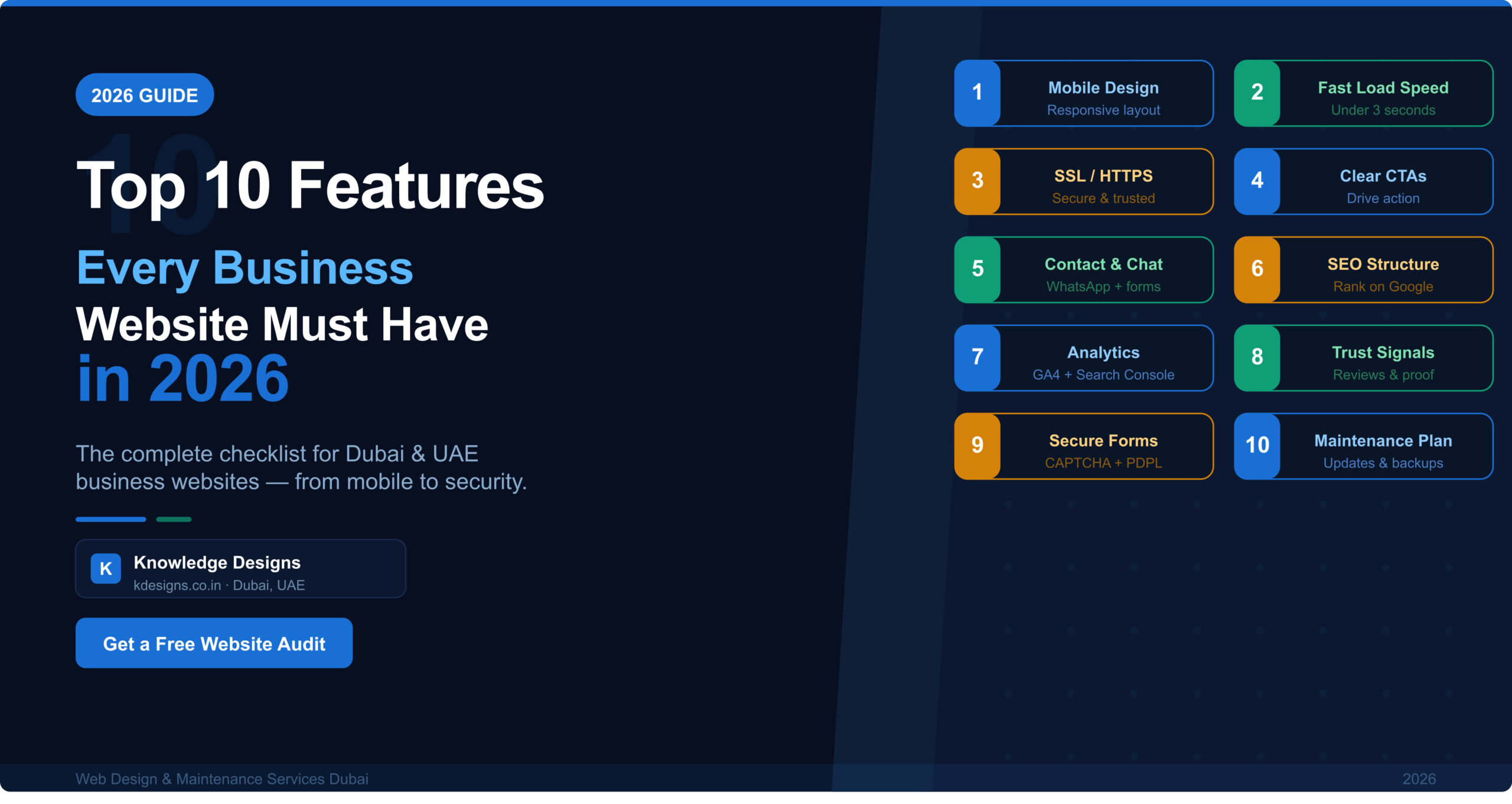
Top 10 Features Every Business Website Must Have in 2026
Your website is your hardest-working employee. It’s live 24/7, it talks to thousands of potential customers simultaneously, and — unlike a staff member — it never calls in sick. But only if it’s built right.
In 2026, customer expectations for business websites have never been higher. Slow load times, broken mobile layouts, and missing trust signals are no longer minor annoyances — they’re revenue killers. Dubai and UAE businesses in particular are competing in one of the world’s most digitally sophisticated markets, where your site is often the first — and only — impression you get to make.
“A website that looks good but doesn’t convert is an expensive brochure. Here’s how to make sure yours does both.”
This guide covers the 10 non-negotiable features that separate high-performing business websites in 2026 from the ones quietly losing customers every day.
WHY THIS MATTERS — KEY STATISTICS
|
Stat |
Data Point |
|
Mobile users worldwide |
63% of all web traffic |
|
Users who leave a slow site |
53% if load time > 3 seconds |
|
Trust impact of SSL |
84% of users abandon a site marked ‘Not Secure’ |
|
Revenue boost from live chat |
Up to 48% increase (Forrester Research) |
|
Impact of reviews on purchase |
92% of consumers read reviews before buying |
|
SEO traffic vs paid ads |
Organic search drives 5× more clicks than paid |
THE 10 MUST-HAVE FEATURES
#1 Mobile-Responsive Design
WHY IT MATTERS: Over 63% of all global web traffic now comes from mobile devices. In the UAE, that figure is even higher — smartphone penetration sits above 99%. If your site isn’t built mobile-first, you are invisible to the majority of your potential customers.
Mobile-responsive design means your website automatically adapts its layout, font sizes, images, and navigation to work perfectly on any screen size — from a 5-inch smartphone to a 27-inch monitor.
The most common mistake businesses make is building a website that looks great on a desktop and assuming it “works fine” on mobile. It usually doesn’t. Buttons are too small to tap, text requires zooming, and menus collapse into unnavigable hamburger icons with no logic.
What to check on your site right now:
- Open your website on your own mobile phone — not a browser preview, an actual device.
- Can you read all the text without zooming?
- Are all buttons large enough to tap comfortably with a thumb?
- Does the navigation menu work intuitively on mobile?
- Do images load at an appropriate size (not cut off or distorted)?
PRO TIP: Google uses mobile-first indexing — meaning it crawls and ranks your site based on the mobile version, not the desktop version. A broken mobile experience doesn’t just lose visitors. It costs you rankings.
#2 Fast Loading Speed (Under 3 Seconds)
WHY IT MATTERS: 53% of mobile users abandon a site if it takes longer than 3 seconds to load. Every additional second of delay reduces conversions by an estimated 7%. Page speed is both a user experience issue and a direct Google ranking factor since 2021.
In 2026, Google’s Core Web Vitals remain the benchmark for website performance. These are three measurable metrics that assess real-world user experience on your site:
- Largest Contentful Paint (LCP): How long it takes for the main content to appear. Target: under 2.5 seconds.
- Interaction to Next Paint (INP): How quickly your page responds to user interactions. Target: under 200 milliseconds.
- Cumulative Layout Shift (CLS): Whether page elements jump around as the page loads. Target: under 0.1.
The most common speed killers are uncompressed images, too many plugins, unoptimised code, and cheap shared hosting with no caching. The fix for most business websites — switching to WebP image format, adding a caching plugin, and connecting a CDN — can take a site from a PageSpeed score of 40 to over 90 without changing a single line of design.
PRO TIP: Run your site through Google PageSpeed Insights (pagespeed.web.dev) right now. A score below 70 on mobile means you are almost certainly losing customers and rankings to competitors who scored higher.
#3 SSL Certificate & HTTPS Security
WHY IT MATTERS: 84% of users will abandon a purchase or enquiry if their browser shows a security warning. SSL is also a Google ranking signal — sites without it are penalised in search results.
An SSL (Secure Sockets Layer) certificate encrypts the data transferred between your website and your visitors’ browsers. You can tell a site has one because the address begins with https:// and there is a padlock icon in the browser bar.
In 2026, there is no acceptable excuse for a business website to be running on HTTP. Most reputable hosting providers include SSL certificates free of charge. If yours doesn’t, switch hosting providers — or speak to your web designer about setting it up immediately.
Beyond the basic SSL certificate, your website should also have:
- A Web Application Firewall (WAF) to block malicious traffic.
- Regular malware scans — automated, not just when something goes wrong.
- A Content Security Policy (CSP) to prevent cross-site scripting attacks.
- Two-factor authentication on all admin logins.
PRO TIP: In the UAE, cybersecurity compliance is increasingly important for businesses that handle customer data. The Dubai Electronic Security Center (DESC) sets guidelines that responsible businesses should align with.
#4 Clear Calls to Action (CTAs)
WHY IT MATTERS: A website without a clear CTA is like a salesperson who gives a great pitch and then stands silently waiting. Visitors need to be told exactly what to do next — every page, every scroll depth.
A call to action is any element on your site that prompts a specific action: Book a Table, Request a Quote, Download the Guide, Call Now, Get Started, WhatsApp Us. The best CTAs are:
- Specific: ‘Get Your Free Website Audit’ performs better than ‘Contact Us’.
- Visible: Above the fold on every key page, not buried at the bottom.
- Singular: One primary CTA per page — multiple competing CTAs confuse visitors.
- Action-led: Start with a verb. Tell the visitor what they will do, not what the page is about.
The most common CTA mistake on UAE business websites is using a generic ‘Submit’ button on contact forms. Replace it with something that reflects the outcome: ‘Send My Enquiry’, ‘Book My Free Consultation’, or ‘Get a Quote Today’.
PRO TIP: For UAE audiences, WhatsApp CTAs dramatically outperform standard contact forms. Add a floating WhatsApp button to every page — it converts at 3 to 4 times the rate of email for local service businesses.
#5 Contact Information & Live Chat
WHY IT MATTERS: Research by Forrester found that live chat increases conversion rates by up to 48% and average order value by 10%. For service businesses in Dubai, contact accessibility is often the deciding factor between an enquiry and a bounce.
Your contact information should never require effort to find. At minimum, your phone number and a contact method should be visible in the header on every single page — especially on mobile. A visitor who has to hunt for your contact details is a visitor about to leave.
Contact features your site should have in 2026:
- Phone number in the header (click-to-call on mobile)
- WhatsApp button — floating, visible on all pages
- Contact form with clear field labels and a meaningful submit button
- Live chat widget (Tidio, Intercom, or WhatsApp Business API)
- Google Maps embed on your Contact page
- Business hours clearly displayed
For businesses operating in multiple emirates or countries, a location-specific contact structure helps Google understand your geographic reach and improves local SEO for each area.
#6 SEO-Optimised Structure
WHY IT MATTERS: Organic search still accounts for the majority of website traffic for most businesses. But a beautiful website that Google can’t read or understand will never rank — regardless of how much you spend building it.
SEO-optimised structure is not about stuffing keywords into your content. It’s about building your site in a way that search engines can crawl, understand, and rank correctly. In 2026, this means:
- A clear URL structure: /services/web-design-dubai is better than /page?id=47.
- Proper heading hierarchy: One H1 per page, H2s for main sections, H3s for sub-sections.
- Meta titles and descriptions: Unique, keyword-rich, and within character limits on every page.
- Image alt text: Descriptive text on every image (also critical for accessibility).
- Schema markup: Structured data that helps Google display rich results in search.
- XML sitemap: Submitted to Google Search Console so all pages are indexed.
- Internal linking: Pages linking to related pages to help both users and search engines navigate.
In 2026, Google’s AI-powered search features (AI Overviews and generative search) also reward structured, authoritative, clearly-organised content. Websites with clean SEO architecture are more likely to be cited in AI-generated answers — a new frontier in search visibility that is growing rapidly in the UAE market.
PRO TIP: Google Search Console is free and shows you exactly which keywords your site currently ranks for, which pages get the most clicks, and what technical errors need fixing. If it’s not connected to your site, set it up today.
#7 Analytics & Tracking
WHY IT MATTERS: You cannot improve what you don’t measure. Without analytics, your website is a black box — you have no idea who is visiting, where they came from, what they’re doing on the site, or why they’re leaving.
Every business website in 2026 should have, at minimum:
- Google Analytics 4 (GA4): Tracks user sessions, page views, traffic sources, conversions, and audience demographics.
- Google Search Console: Shows search performance, keyword rankings, indexing status, and technical errors.
- Heatmap tool (Hotjar or Microsoft Clarity — both free): Shows where users click, how far they scroll, and where they drop off.
Beyond the basics, a well-configured analytics setup will track specific conversions — form submissions, phone clicks, WhatsApp taps, and reservation completions — so you know which pages and which traffic sources are generating actual revenue, not just visits.
This data is what separates businesses that grow their website strategically from those that redesign every few years on gut feeling and hope for the best.
#8 Trust Signals & Social Proof
WHY IT MATTERS: 92% of consumers read online reviews before making a purchase decision. For UAE businesses, where word of mouth and reputation are paramount in many sectors, trust signals can be the single most powerful conversion lever on your site.
Trust signals are any element on your site that reduces the perceived risk of doing business with you. They include:
- Google reviews widget (showing live, real reviews from your Google Business Profile)
- Client logos or ‘As seen in’ press badges
- Case studies with real results and client names
- Professional accreditations and certifications
- Number of clients served, years in business, projects completed
- Before-and-after portfolio examples with context
- A clearly written privacy policy and terms — signals legitimacy
One of the most overlooked trust signals is team photos with real names and roles. Especially in the UAE market, where relationship-driven business is the norm, putting a face to the business dramatically reduces the psychological barrier to making first contact.
PRO TIP: Don’t just collect reviews — display them. Your Google rating and review count should be visible on your homepage without the visitor needing to search for it. Every positive review you’ve earned is part of your website’s conversion arsenal.
#9 Secure, Functional Contact Forms
WHY IT MATTERS: Your contact form is the final step in the conversion journey. A form that’s broken, confusing, spam-filled, or non-compliant is a conversion wall standing between you and every potential customer who tries to reach you.
In 2026, a properly built contact form is more than a Name / Email / Message box. It should be:
- CAPTCHA-protected: Google reCAPTCHA v3 or hCaptcha to stop spam bots — without forcing users to identify traffic lights.
- Confirmation-triggered: Send an automatic confirmation email to the visitor the moment they submit.
- Notification-enabled: Alert you (and your team) instantly via email or Slack when a form is submitted.
- CRM-connected: High-volume businesses should pipe form submissions directly into a CRM (HubSpot, Zoho, or Pipedrive).
- GDPR/UAE PDPL compliant: Include a checkbox for marketing consent and a link to your privacy policy.
The UAE Personal Data Protection Law (PDPL) came into force in 2023. Any business website collecting personal data from UAE residents — including simple contact forms — must handle that data in compliance with PDPL requirements. Non-compliance carries fines and reputational risk.
#10 Regular Maintenance & Update Plan
WHY IT MATTERS: A website is not a one-time project — it’s an ongoing asset that requires care. Outdated plugins, expired SSL certificates, broken links, and stale content slowly degrade your site’s performance, security, and search rankings over time.
The most common reason business websites underperform isn’t poor design — it’s neglect. A site that was excellent at launch in 2023 will be mediocre by 2025 and potentially dangerous by 2026 if it hasn’t been maintained.
A minimum maintenance schedule for 2026:
- Weekly: Check for plugin and theme updates. Review uptime monitoring alerts.
- Monthly: Apply WordPress core, plugin, and theme updates. Run a full site backup. Check Google Search Console for new errors. Review page speed scores.
- Quarterly: Run a full security and malware scan. Audit and fix broken links. Review and refresh key page content. Check all forms and CTAs are functioning.
- Annually: Full SEO audit. Review hosting plan and server performance. Reassess the site against current competitor standards.
For Dubai businesses that rely on their website for leads, bookings, or sales, a monthly maintenance retainer with a web designer or agency is not an overhead — it’s business continuity insurance.
PRO TIP: Automated daily backups stored off-server mean that even in a worst-case scenario — a hack, a failed update, a server crash — your site can be fully restored in minutes rather than days.
YOUR 2026 WEBSITE QUICK-CHECK CHECKLIST
|
Feature |
Action to Check |
|
|
#1 |
Mobile-responsive design |
Test on real device — not just browser resize |
|
#2 |
Fast load speed (under 3s) |
Run PageSpeed Insights — aim for 90+ score |
|
#3 |
SSL certificate (HTTPS) |
Check padlock in browser address bar |
|
#4 |
Clear calls to action |
Every page must have one primary CTA above the fold |
|
#5 |
Contact info + live chat |
Phone/WhatsApp visible in header on all pages |
|
#6 |
SEO-optimised structure |
Meta titles, H1s, image alt tags all in place |
|
#7 |
Google Analytics + Search Console |
Both tools connected and receiving data |
|
#8 |
Trust signals & testimonials |
Real reviews visible on homepage |
|
#9 |
Secure contact forms |
CAPTCHA enabled, GDPR-compliant, tested |
|
#10 |
Regular maintenance plan |
Updates, backups, security scans scheduled |
How do I know if my website has all 10 features?
The quickest way is to run your site through Google PageSpeed Insights for speed, check for an HTTPS padlock in your browser bar for SSL, and test the site on your own mobile phone for responsiveness. For a complete audit covering all 10 areas, request a free website audit from a qualified web designer.
Which of these 10 features should I prioritise if I have a limited budget?
In order of impact: mobile responsiveness (#1), page speed (#2), and SSL security (#3). These three features affect the widest number of visitors and have the most direct impact on both conversions and search rankings. Everything else builds on top of this foundation.
Can I add these features to my existing website, or do I need a full rebuild?
Most of these features can be added to an existing WordPress website without a full rebuild. Speed optimisation, SSL, analytics, contact forms, and CTA improvements are all retrofittable. Mobile responsiveness is the exception — if your site was built on a non-responsive theme, a rebuild or theme migration is usually the most cost-effective path.
How much does it cost to implement all 10 features for a Dubai business website?
For a new build, a properly built WordPress website including all 10 features typically ranges from AED 3,500 to AED 12,000 depending on the size and complexity. For an existing site, retrofitting these features through an audit and upgrade project typically ranges from AED 1,200 to AED 4,500. Ongoing monthly maintenance plans in Dubai range from AED 350 to AED 2,850 per month.
Is your Dubai business
website ready for 2026?
Get a free, no-obligation website audit from Knowledge Designs. We’ll review your site against all 10 features and give you a clear, prioritised action list — no sales pitch, just honest advice.